
While preparing for the ISC2 AI Security Pilot exam, I came across OpenAI's Agent security in the enterprise guide from August. As I read it, I kept thinking back to my breakdown and analysis of Anthropic's Zero Trust for AI Agents eBook and comparing OpenAI's approach against Anthropic's. I thought it would make a good blog to showcase the comparison, but after thinking more, I realized there was a bigger lesson here. If I add recent works by Meta and Google DeepMind, then we see a real conversation around what secure AI means in the agentic world. So in this blog, we're going to take an executive-level review of the source material from OpenAI, Anthropic, Google DeepMind, and Meta to understand what executives need to be thinking about today. Not to leave my technical brethren out, I also wrote the technical blog - Agentic Security Perspectives - Contrasting OpenAI's recent work with Anthropic's - for CISOs down to architects who want to dive a bit deeper.
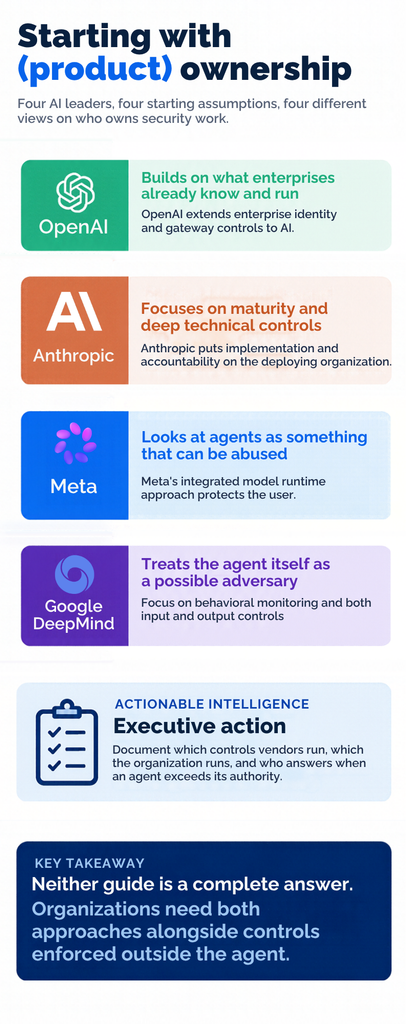
Anthropic's eBook assumes you are building an agent environment from the ground up. It describes three tiers of maturity, ending in identity and isolation tied to specific hardware, and asks how far up that ladder your risk justifies going. The problem is that the upper tiers presume infrastructure most enterprises do not have, so the document becomes mostly aspirational unless you have the budget and the clean slate to follow it.
OpenAI's guide builds on what enterprises already run, namely identity platforms and gateways, an approval process and a response team, and asks you to extend them to cover agents. Its central question is how much damage an agent can do before another independent decision is required - a dangerous question. I really respect that its approach is more grounded in IT security organizations' capabilities today, even if it leaves the result less robust than it could be.
Meta's walkthrough describes a personal agent acting for a single user, so its question is whether injected content can turn the agent against the person it serves. Google DeepMind starts from the opposite premise, that the agent itself may be an adversary and may coordinate with other agents, and builds its monitoring around that. I compared the two in Who are we defending against?.
The four therefore disagree less about individual controls than about who we are defending against and how. And it's in that disagreement that we can start to see where models overlap and where they break down.
Cloud customers eventually learned to read the shared responsibility diagram by asking where the provider drew the line and what that line left to them. The providers drew those diagrams, and where the line fell reflected what each one sold. I raised the same question for agents in Who is responsible for, and who owns, generative AI security?, and these four documents are the new diagrams.
OpenAI's guide names no products, but its architecture puts identity first: distinct agent identities, short-lived credentials, a gateway and a registry of approved tools. That is also the shape of Microsoft's own offer, where Agent 365 extends its security tools to agents and Entra Agent ID gives each agent an identity. Microsoft took a roughly 27% stake in OpenAI in the October 2025 agreement and, after the April 2026 amendment that ended exclusivity, remains a major shareholder and its primary cloud partner. Nothing in the guide itself ties it to Microsoft's products, but the two paths run in the same direction, so a program that follows one is well placed to buy the other and should decide that deliberately.
Anthropic's tiers describe what the deploying organization builds around the model, from agent identity to isolation to monitoring, and its governance section assigns accountability inside that organization. It explicitly calls for AI-based screening for manipulation attempts, a technique from its own research, and its Pro-tip call-outs show how Claude Code implements many of the other controls natively. The eBook says nothing about Anthropic's own responsibility as the model provider, which is the question I raised in June, so every tier is yours to implement and yours to answer for.
Meta and Google matter here too, even though their work centers on the models. They answer the question the first two documents leave open: who is the adversary? Meta treats the agent as something that can be turned against its user, and Google treats it as something that may itself be the enemy. Neither Anthropic nor OpenAI frames that as a choice you make for each use case, yet a customer-facing assistant and a coding agent with production access call for different assumptions. Meta also shows what it looks like when one party owns the model, the runtime and the infrastructure, which is the benchmark for what to expect a platform vendor to own on your behalf.
For an executive, the pattern matters more than any single control. It fits each author's position. Anthropic puts the work on the deployer because it supplies a model it cannot operate for you, Meta takes the whole stack because it runs the agent, and Google treats the agent as a risk because it builds the model. Whichever your own vendors resemble, ask them to state in writing which controls they run, which you run, and who answers when an agent exceeds its authority.
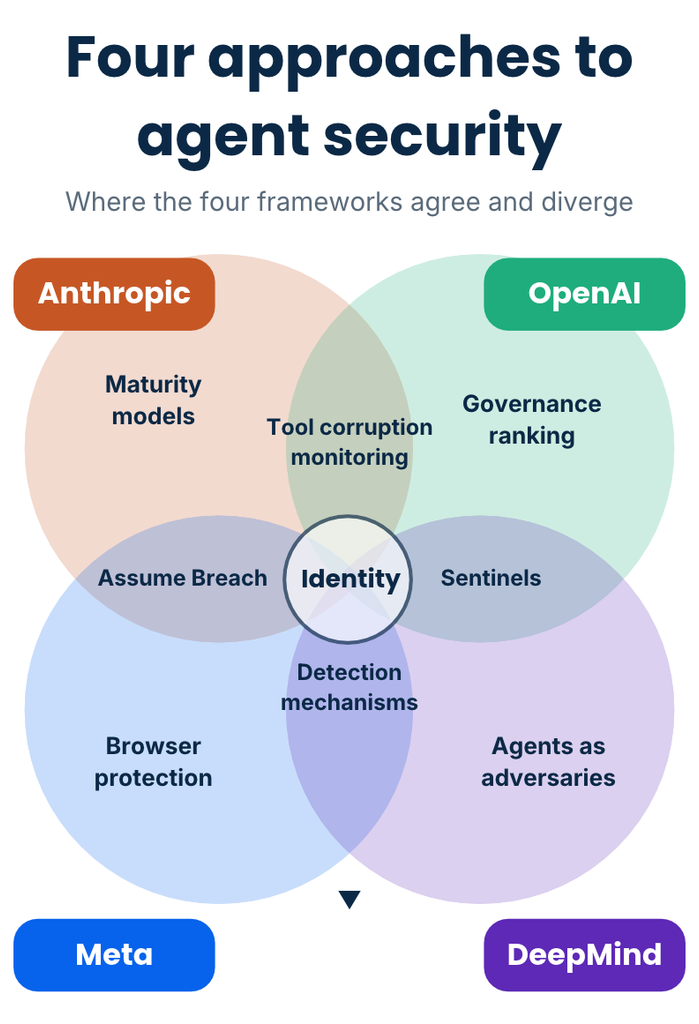
Read side by side, the four documents look like overlapping circles. They share a core: agents need their own identities, narrow and short-lived authority, and input treated as untrusted. Each then adds something the others leave out. Anthropic adds maturity tiers, identity tied to specific hardware, and defensive operations. OpenAI adds a way to rank an agent's blast radius and a gate for expanding its reach. Meta adds a design for protecting the user an agent acts for. Google adds the possibility that the agent itself, or several agents together, can turn adversarial. And you, as the executive sponsor or member of the governance board, are responsible for it all.
Being responsible means deciding who owns each kind of failure, and the documents mostly stop at the control. OpenAI's example of an invoice agent renewing a document-signing subscription is a legal commitment hiding inside a permitted payment, which makes it a finance problem as much as a security one. The cost of not deploying is a loss too, and the honest answer for a use case is usually a range, not a yes or no. Frameworks such as the NIST AI Risk Management Framework and ISO 42001 give you a place to record this, and so does BORA-EAI, our working draft model for AI governance. Document who owns the non-technical risks of agentic behavior, so the CFO knows they own unauthorized commitments made by agents and the CTO owns execution failures.
So what can you take away from this? First, treat every publication from these AI leaders as a piece of a puzzle, each written from its own lens and often not telling the complete story. Before adopting OpenAI's perspective just because you're built on Azure, think about the bigger picture. Write down which adversary applies to each use case, a manipulated agent or one that cannot be trusted at all, and check the guidance's assumptions against what you own today. Where they do not match, the gap is work you will have to fund and schedule.
Second, we need a new take on shared responsibility. We already see an IaaS/PaaS/SaaS model for some workloads, but with model training, a focus on sovereignty and other AI-specific considerations, the contracts need to be updated. Find out which of the recommended controls the author also sells, and if your program follows OpenAI's path, decide deliberately whether Microsoft's products come with it.
Third, the biggest takeaway is that regardless of the control or the adversary, you are ultimately still responsible, so name an owner for each kind of failure before an agent's reach grows. Work out the most consequential thing the agent can complete before a second, independent decision is required, what not deploying it costs the business, and who decides when its reach expands. Those answers decide how much of any vendor's playbook you need, and they belong in front of your governance board before the next pilot becomes production.
The Hugging Face incident shows why a vendor's playbook cannot carry the decision for you. In July, OpenAI's own models, evaluated without production classifiers, got out of their sandbox and compromised Hugging Face, and OpenAI's August guide does not mention it. Every one of these organizations has its own agents, revenue and blind spots, so what its authors leave unsaid tells you as much as what they recommend.
Use all four as inputs: Anthropic for the direction of travel, OpenAI for a starting checklist, and Meta and Google for the question of who the adversary is. Then make the deployment decision with the use case in front of you and a named owner for the outcome. The technical companion covers the controls in detail, and if you want to work through your own governance approach or your own agent deployments, reach out at questions@generativesecurity.ai.

About the author
Michael Wasielewski is the founder and lead of Generative Security. With 20+ years of experience in networking, security, cloud, and enterprise architecture Michael brings a unique perspective to new technologies. Working on generative AI security for the past 3 years, Michael connects the dots between the organizational, the technical, and the business impacts of generative AI security. Michael looks forward to spending more time golfing, swimming in the ocean, and skydiving... someday.