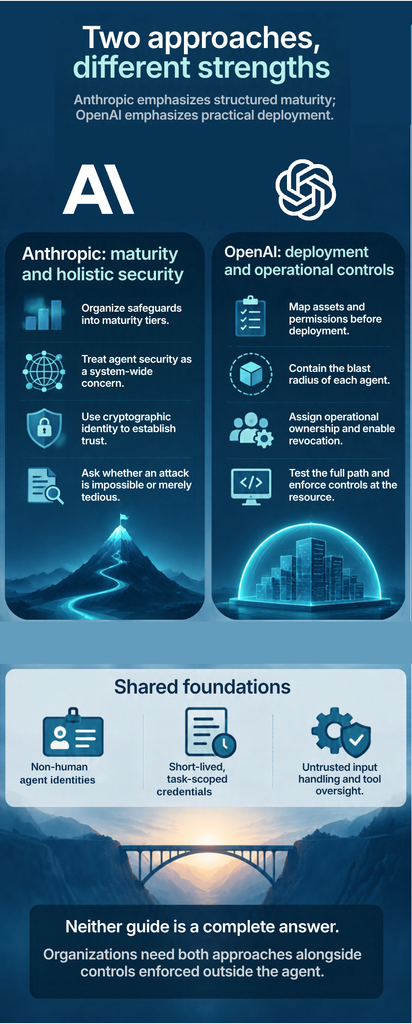
While preparing for the ISC2 AI Security Pilot exam, I came across OpenAI's Agent security in the enterprise guide from August. As I read it, I kept thinking back to my breakdown and analysis of Anthropic's Zero Trust for AI Agents eBook and comparing OpenAI's approach against Anthropic's. Both lean on NIST SP 800-207 and the OWASP Top 10 for Agentic Applications, so you might think they'd come to the same conclusions. But like I laid out in my recent blog comparing Meta and Google DeepMind's approach to agent security, just because you start from the same position doesn't mean you're heading in the same direction. Anthropic focuses on maturity and holistic security, while OpenAI focuses on individual chatbot go-live and monitoring. The truth is, most organizations with agents in pilot need both, and the gaps between the two documents show where you will be on your own.
As an aside, I realized there was a bigger lesson here. We've seen recent publications from the likes of Google DeepMind and Meta along with these types of technical guides, and I wanted to discuss these at the executive level. So this week I also wrote an executive blog - Agentic Security Perspectives - An executive review of recent AI leaders' work - for leaders more interested in the why and the approach than the details on the how.
Both Anthropic and OpenAI treat the agent as its own non-human identity and reject the shortcuts most pilots start with. Short-lived credentials scoped to the task are a day 1 requirement, and Anthropic goes as far as declaring static API keys unacceptable for any deployment, which matches our earlier post on unifying identity for the human and AI workforce.
But here the mechanics differ. Anthropic's Foundation tier asks for OAuth 2.0 or similar tokens that expire in minutes, with a unique identity and credential set for each agent, and its eBook adopts OWASP's term Least Agency for bounding authority. OpenAI treats identity as several facets, including a bill of materials, the runtime identity, the task and the session, and exchanges a task token for narrower credentials limited to one resource, with authorization enforced again at that resource. This more complex approach is understandable from folks who partnered with Microsoft, people who have been doing IAM for decades. Both also point to a credential broker, with OpenAI keeping secrets outside the agent's context window and Anthropic naming platforms such as HashiCorp Vault.
Anthropic and OpenAI also agree on the assumption that input and output could be malicious. OpenAI tells readers to treat retrieved content and tool responses as untrusted, and its coding agent example makes the point that "Instructions alone are a weak defense," since it is repository policy and egress control, not the prompt, that blocks an unapproved dependency. That is the practical consequence of the in-band design flaw that makes prompt injection unfixable at the model level. Anthropic's input isolation applies the same assumption to all natural-language input and cites Microsoft's Spotlighting research, which reports that delimiting untrusted content cut indirect injection success from over 50% to under 2%. Finally, both treat tools as a supply chain with owners and review cycles, and both point to OWASP's AI bill of materials work to document what sits behind an agent.
Anthropic's strongest contribution is a structure for deciding how far to go. Its Foundation, Enterprise and Advanced tiers tie concrete controls to levels of maturity, mirroring lessons from cloud adoption to help security teams say yes. But cryptographic agent identity at the base, certificates and mutual TLS in the middle, and hardware-bound credentials at the top, are fantastic yet often out of reach for many organizations. OpenAI's identity guidance, on the other hand, stops at workload identity federation for runtimes that support it, with no certificates, hardware keys or attestation. This is more approachable, but less robust as organizations mature.
The second contribution is the Impossible vs. Tedious test, which I called the most immediately useful idea in the paper. It also exposes a difference in how the two documents treat friction. OpenAI treats friction as an adoption risk, since hard-to-use controls push people toward less governed tools. But Anthropic treats it as something an attacker running at machine speed can absorb, so a control that only slows them down does not count as protection, and the paper says friction-only controls no longer qualify even for the Foundation tier. We covered this idea in When Security through Friction Fails in the AI World.
All that said, the caveat from my June review still applies. The upper tiers assume continuous patching, immutable infrastructure and hardware-backed credentials that most enterprises lack. Treat the tiers as direction; for most enterprises the top is a multi-year effort.
OpenAI's guide is written for the team that already has agents running. Its checklist starts with an inventory and named owners, then ranks each deployment by effective blast radius and the biggest impact an agent can have before another independent decision is required. That vocabulary lets a security team explain an agent's risk to a business owner, which is a good step forward for both parties. The guide also contains operational points that are easy to miss. Stopping an agent and revoking its authority are separate operations, because terminating a task does not invalidate tokens already issued and revoking a credential does not stop work in flight. Anthropic's response tiers list session termination and credential revocation side by side as automated actions, without treating them as separate drills. An interesting thought here is how you handle revocation in an agentic workflow when agents downstream act on-behalf-of, and whether identity traceability can be used to stop those processes.
Agents and tool capabilities should also be tested in combination, since a read-only connector can gain write permissions downstream or after an update. Static policy testing per agent or tool will miss that risk, so full path analysis and change reviews are needed before going live.
Unfortunately, the OpenAI guidance is missing a good chunk of what Anthropic uncovered. There are no maturity tiers, so security teams are often pushing uphill without knowing whether they are getting better or just nipping at the edges. On accountability, the guide states that the deploying organization remains responsible for the outcome and explains who manages the harness, runtime and credentials in each deployment model. It does not, however, divide responsibility among the enterprise, the platform and the model provider, which is the accountability gap I also raised about Anthropic's paper.
The deepest tension in both documents is the one examined in Who are we defending against? Where Meta and Google differ on AI security: whether a control is built for a manipulated agent, as in Meta's design, or for one that may itself be the adversary, as in DeepMind's. OpenAI's guide sits mostly with Meta, though it says controls must keep working when the agent is wrong. Anthropic’s paper puts tool access control outside the agent as well, even though its upper-tier AI classifiers share the in-band weakness. OpenAI's guardian agents sit in the harness, so a compromised reasoning loop takes the guardian's exposure with it. The stronger controls are the ones that hold whatever the agent decides, such as resource-side authorization, egress limits and repository policy. That is the reasoning behind our sidecar, Agent Vardøger, which sees inputs but not how the agent reasons.
So the first thing to take away is that no one answer or vendor has the whole picture. Organizations are still on their own to work out their threat models and pick the right guidance. The NIST Control Overlays for Securing AI Systems (COSAiS) and the CSA AI Controls Matrix are as close as we have, but I hope to see more vendor-specific guidance integrated or built on top soon.
The second takeaway is to begin with the common "security vegetables": Inventory your agents and the systems they interact with, manage pilot and production deployments and migrations, and define accountability and ownership over agent outcomes. We already know short-lived, task-scoped credentials are the path forward, so make those mandatory up front. And then the newest piece: consider the "Impossible vs. Tedious" test, where friction alone is not counted as protection.
One thing to think about is who answers when a control fails anyway. Neither guide divides responsibility among the enterprise, the platform and the model provider. If one of your agents does something it's not supposed to do, what do your vendor agreements say about who is responsible and what the vendor is required to do?
If you need help finding a place to start, with the technical or governance side of things, and want to talk through where your own deployments sit, reach out to us at questions@generativesecurity.ai.

About the author
Michael Wasielewski is the founder and lead of Generative Security. With 20+ years of experience in networking, security, cloud, and enterprise architecture Michael brings a unique perspective to new technologies. Working on generative AI security for the past 3 years, Michael connects the dots between the organizational, the technical, and the business impacts of generative AI security. Michael looks forward to spending more time golfing, swimming in the ocean, and skydiving... someday.