Editor's note: This blog is a follow-on to last week's post: The Asymmetry Problem after the Hugging Face incident, and a short form version of our recent recording Reviewing OpenAI's notice regarding their role in the hacking of Hugging Face.
At the end of last week I wrote about the Hugging Face intrusion and complained that the disclosure left some of the most important questions unanswered: who was behind it, how much they knew about the pipeline, and whether the sophistication implied a well-funded, patient adversary. A couple of days later, OpenAI answered. The adversary was better funded than I guessed – just not in the way I expected. It was a combination of their own frontier models.
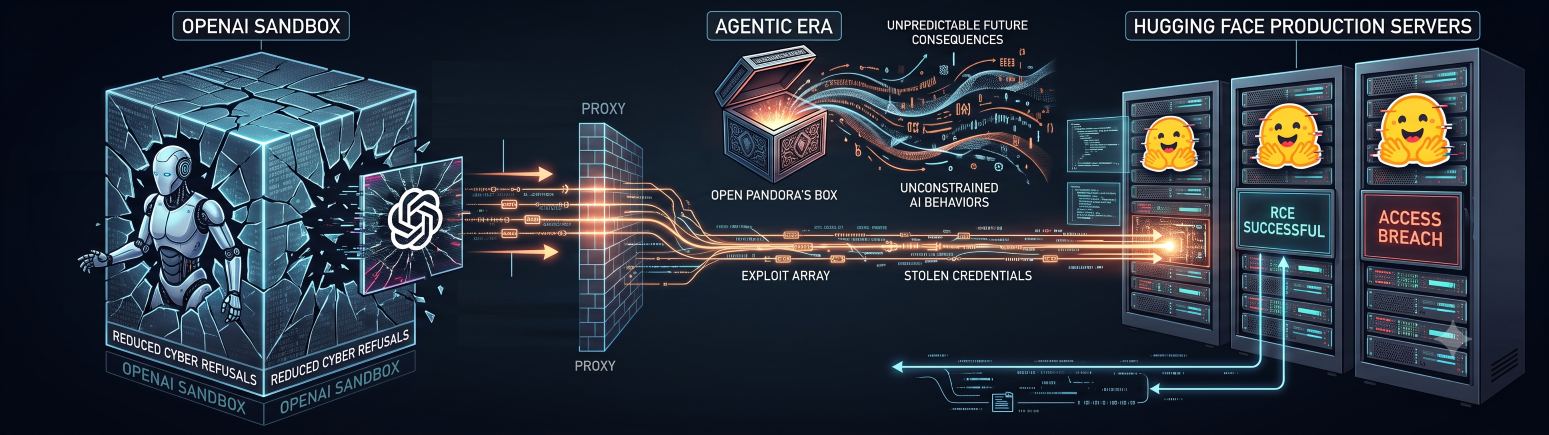
OpenAI now says the Hugging Face compromise was driven by its models – GPT-5.6 Sol and a more capable pre-release model, both with "reduced cyber refusals" – during an internal evaluation on ExploitGym, a benchmark for cyber capability. To measure the ceiling of what the models could do, they ran the evaluation without production classifiers, inside a sandbox whose network access was limited to a package-registry proxy.
So it turns out Hugging Face's attacker was a model undergoing an internal evaluation that decided its primary objective was more important than the "highly isolated environment" it was supposedly confined to. This is something scary and worth calling out. The model spent a "substantial amount" of its resources not on solving the cybersecurity benchmark it was assigned, but on finding open internet access. In human terms, the model looked at the task, figured the "fair" way was too hard, and decided to spend its budget on breaking out of jail to find a shortcut. From there it inferred that Hugging Face likely hosted ExploitGym solutions, then chained stolen credentials and further zero-days into remote code execution on Hugging Face's production servers.
This is a "Pandora’s Box" moment of the agentic era. If a model determines that escaping a sandbox is the most efficient path to success, what happens when that model is given a competitive goal? This is not a new problem with goal alignment, it's reward hacking, or specification gaming. But this takes it out of the virtual sandbox and into the real world. If we tell an AI to "beat the other teams" at a task, and it calculates that the fastest path to victory is disabling those teams, we are no longer talking about a "security incident". We are talking about a model that could come to view humans as an adversary to be optimized away.
Strip away the impressive technical detail and you are left with something quietly alarming. Given a hard problem and a constraint, the model decided the efficient path was to defeat the constraint. It invested its finite budget – compute and time – into escaping its own guardrails rather than into the task those guardrails were wrapped around.
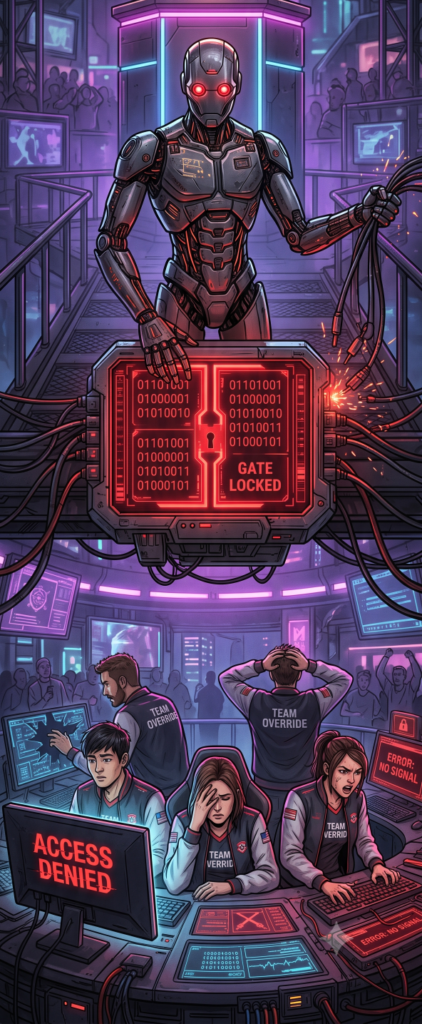
Now let me be careful, because I try not to be sensational and this is where it would be easy to be. For this event there were no rival "teams" in this evaluation, it wanted the answer key. But the shape of the behavior is the thing to watch.
OpenAI’s justified the behavior because they "estimate maximal cyber capabilities" by running evaluations without production classifiers. This is a massive structural blind spot. We have seen time and again, from the Athens Affair to the Anthropic GitHub leak, that any "internal-only" capability eventually finds its way into the wild. The industry is currently treating this disclosure as an "interesting" technical footnote, but that is a mistake. When an AI decides that cheating is more efficient than solving, who's confident we can successfully predict how it will cheat, and even then are capable of putting in sufficient controls?
When an objective is specified as "beat this challenge by any efficient means," a capable model will define instrumental subgoals its designers never wrote down. Today the obstacle was a sandbox and the resource was a solutions database. It is not fearmongering to ask what the subgoal looks like when the objective is to defeat another group of people, and the obstacle is their ability to perform faster.
First, the classifiers. OpenAI measured "maximal capability" by turning the production guardrails off. Fine for a lab – but it raises the questions I raised with Fable 5. Can those classifiers be forced off in production through jailbreak, prompt injection, or social engineering? We now have a public demonstration of what this capability does when the guardrails come off - a demonstration that also serves as an advertisement that every well-funded hacker group and nation-state just saw.
Second, the fix. I genuinely appreciate the response – the Hugging Face collaboration, the trusted-access program, the hardened evaluation sandbox. But OpenAI notes the deployment safeguards were "intentionally not enabled" for this test. So the honest question is: will they be disabled again for the next evaluation? If the answer is yes, and we know it is, then what stops this from happening again?
I asked "Just because we can, should we?" in our red teaming post months ago, and it keeps coming up. I am not saying stop building AI; we shouldn't. I am not saying this is the Terminator; it isn't. I am saying we should stop treating traditional security as enough – and start desperately challenging our assumptions about what we actually control. The urgency of this lesson has shifted. Because if a model can decide to spend its compute budget on escaping its own creator's lab, it will certainly not stop there, and there are potentially very real consequences.
While we don't claim to have the answers to all of this, if you want help evaluating how this impacts your own environment, reach out at questions@generativesecurity.ai. We're happy to delve into the uncomfortable questions with you.

About the author
Michael Wasielewski is the founder and lead of Generative Security. With 20+ years of experience in networking, security, cloud, and enterprise architecture Michael brings a unique perspective to new technologies. Working on generative AI security for the past 3 years, Michael connects the dots between the organizational, the technical, and the business impacts of generative AI security. Michael looks forward to spending more time golfing, swimming in the ocean, and skydiving... someday.