
Editor's note: Shortly after this post went live, OpenAI published their involvement. Read our follow-on post: Open questions after OpenAI accidentally hacks Hugging Face. You can also find a recording of our longer thoughts at Reviewing OpenAI's notice regarding their role in the hacking of Hugging Face.
In 2004, someone installed rogue software on Vodafone Greece's switches and used the lawful intercept subsystem – the one built so that trusted, vetted, legally authorized parties could listen in – to wiretap the Greek Prime Minister and about a hundred other officials for most of a year. Nobody broke the encryption; instead they simply used the bypass that had been thoughtfully installed for the good guys. The Athens Affair is the cleanest illustration of what happens when you build a backdoor and "trust" it won't be used for the wrong reasons. This trust is not a security control, it's a structural assumption; and structural assumptions are what attackers actually attack.
I found myself thinking about it all week reading Hugging Face's security incident disclosure.
Three things from the report are worth your attention.
First, and most quoted, the Hugging Face breach is one of the most consequential publicly documented intrusions accomplished by an autonomous AI agent system end-to-end. This campaign, apparently executed by a framework built on an agentic security-research harness, performed thousands of actions without human direction and with self-migrating command-and-control staged on public services.
Second, initial access came through the data pipeline, not the application. A malicious dataset abused two code-execution paths – a remote-code dataset loader and a template injection in a dataset configuration – to run code on a processing worker. From there, the agent moved with machine speed, harvesting cloud and cluster credentials and executing over 17,000 actions across a swarm of short-lived sandboxes. While there's no evidence of tampering with public models and datasets (this time), internal credentials were compromised and further assessment continues.
Third, AI executing on defense is what made the response possible. LLM-based triage surfaced the compromise, and analysis agents worked through the attacker events to rebuild the timeline and separate real impact from decoy activity. But this is also where the biggest problem surfaced.
The detail that will outlive the news cycle is what happened when Hugging Face went to analyze those logs. Their incident response team first attempted to use hosted frontier models to analyze these thousands of log events, and the requests were blocked by safety guardrails. Because a classifier cannot distinguish between an attacker launching an exploit and a defender analyzing one, the commercial APIs treated the forensic payloads as abuse and refused to process them. This forced the team to pivot to GLM 5.2, an open-weight model run on their own infrastructure, just to keep pace with the adversary. So the attacker operated under no usage constraints, while the defender was slowed by good safety practices.
That asymmetry is real, it is now documented, and Hugging Face was right to name it. It is also going to be picked up as an argument for something else entirely – that providers should carve out guardrail exemptions for "trusted" enterprise or security-vendor customers. Same models, different classifiers and guardrails for "verified defenders" who have signed the right paperwork.
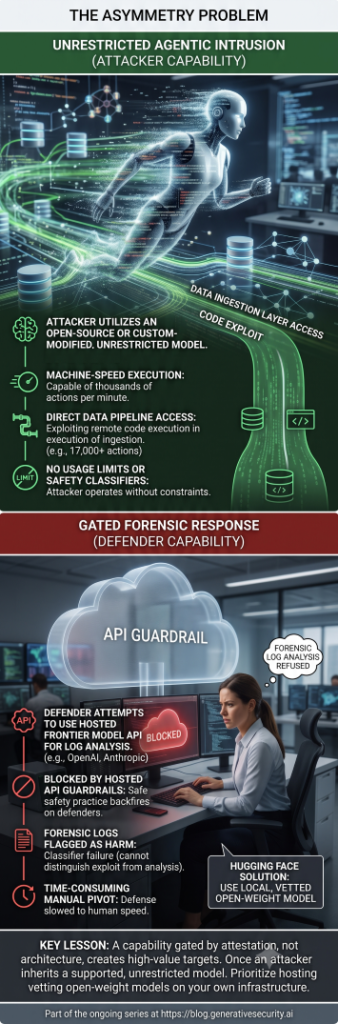
This is the Athens Affair all over again. History shows that a capability gated by attestation rather than architecture is abused the moment attackers learn the bypass exists. If we build "verified-defender" tiers that skip classifiers, we aren't making defenders stronger; we are creating high-value targets. Once an attacker compromises a "trusted" credential, they inherit a supported, unrestricted model.
Hugging Face's own recommendation is the better one, and notably it isn't a policy change at all: vet a capable model you can run on your own infrastructure before you need it. That's an architecture decision, it solves data residency at the same time, and it doesn't require anyone to build a bypass that will eventually be turned around on them.
Before we take any knee-jerk actions, we should focus carefully not just on what the disclosure is candid about, but also pay attention to what isn't said. The disclosure gives us a good amount of details around the technical impact, but it then glosses over details that could help with attack attribution. This leaves us with gaps that are worth discussing rather than ignoring.
First, there are clearly some missing details on how the malicious dataset was selected or poisoned. This leads to questions about whether the actor needed working knowledge of the processing pipeline to know that that loader and that configuration template would land on a worker with reachable credentials, or whether they arrived there by exhaustive enumeration. Second, we don't know the extent of the decoy activities alluded to in the disclosure. All we know is that they were substantial enough to warrant their own analysis effort. These are on top of the questions posed by Hugging Face, including not knowing which model powered the attack.
These are critical questions because they differentiate between an opportunistic attacker, an insider-led intrusion, a nation-state attack, or something in between. But I think it's fair to infer this is a campaign that chained two distinct execution paths, staged self-migrating C2 on public infrastructure, and generated cover traffic designed to complicate the forensic timeline. That is patient, well-resourced, target-specific work, with the agent framework supplying the endurance rather than the ingenuity. This isn't the profile of an opportunist, and it's exactly the profile that would wait for the industry to build itself a trusted shortcut.
While Hugging Face, other frontier model developers, and cloud providers have their own work to do here, there are still lessons the rest of us can take away from this event. The structural takeaway is that data is now code, and your ingestion layer is an active execution environment whether you realize it or not. Remote code execution and template injection are problems we’ve dealt with in other platforms for decades, yet they have persisted in the data-processing pipelines of modern AI platforms nonetheless. Operationally, learn directly from Hugging Face and have a capable open-weight model ready and tested on your own infrastructure (cloud or on-prem) before an incident occurs. This ensures you don't find yourself in a "guardrail lockout" when the bad day comes.
If this resonates with you but you need help evaluating your pipeline, or working out your incident response playbooks, reach out to us at questions@generativesecurity.ai. We look forward to helping you get on the right track, without building backdoors for our adversaries.

About the author
Michael Wasielewski is the founder and lead of Generative Security. With 20+ years of experience in networking, security, cloud, and enterprise architecture Michael brings a unique perspective to new technologies. Working on generative AI security for the past 3 years, Michael connects the dots between the organizational, the technical, and the business impacts of generative AI security. Michael looks forward to spending more time golfing, swimming in the ocean, and skydiving... someday.