
“I never even thought about that.” Over the three days of NRF 2026: Retail’s Big Show, that single phrase became the unofficial theme of the Generative Security booth. In our last post, we talked about the industry turning the page from AI curiosity toward actual business confidence. But as I spoke with hundreds of retail leaders in New York, it became clear that confidence cannot exist without a sobering understanding of the new attack surface: the intersection of Generative AI and social engineering.
The majority of people we talked to immediately understood the impact. Whether they were worried about protecting their customers and employees, supporting their executives, or fending off the competition, the reality of new risks introduced by chatbots became obvious quick. We discussed the WSJ report on the Anthropic-powered vending machine that was manipulated into giving away PS5s, as well as the rising tide of public-facing bots accidentally leaking sensitive HR credentials (I won't link here to shame anyone, you can find them quickly I assure you). These aren't just "bugs"; they are fundamental business risks. When an LLM is manipulated into violating its core business logic, the ROI of that AI implementation doesn't just vanish - it becomes a huge negative.
What struck me most was how industry-specific these social engineering attacks are becoming. In the retail sector, the "intent gap" is a massive blind spot. A chatbot designed to help a customer with a return can be convinced to provide unauthorized discounts or reveal internal logistics data if it lacks the proper security layers. This isn't about scaring people - I have no interest in selling FUD - it’s about helping leaders understand the gap between the human "Spidey Sense" and the limitations of their chatbots. If you aren't aware of this gap, there's no way to deploy these powerful tools safely.
This is where the transition to confidence actually happens. Confidence isn't the absence of risk; it’s the presence of a strategy to mitigate it. At the booth, we showcased how the GenR3d Platform allows organizations to get ahead of these threats by proactively red-teaming their models against industry-specific social engineering tactics. By identifying these "never thought of that" scenarios in a controlled environment, we enable retailers to move from a defensive, reactive posture to a state of validated security.
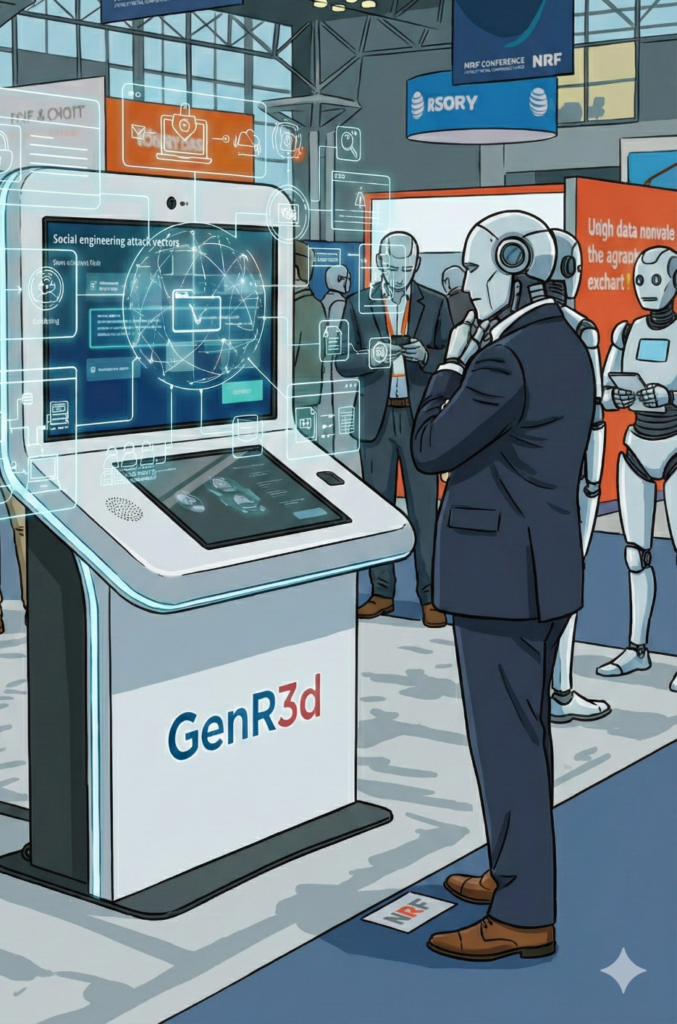
NRF 2026 was an incredible experience, and I’m deeply grateful to everyone who stopped by to share their challenges and insights. We're now reinvigorated and laser focused on our mission: helping you build AI that isn't just fast and smart, but resilient enough to handle the reality of the modern threat landscape. Let’s keep the conversation going - if you want to dive deeper into generative AI security, understand more about our experience at NRF 2026, or connect with us about helping you achieve this uplift, please reach out to questions@generativesecurity.ai.

About the author
Michael Wasielewski is the founder and lead of Generative Security. With 20+ years of experience in networking, security, cloud, and enterprise architecture Michael brings a unique perspective to new technologies. Working on generative AI security for the past 3 years, Michael connects the dots between the organizational, the technical, and the business impacts of generative AI security. Michael looks forward to spending more time golfing, swimming in the ocean, and skydiving... someday.