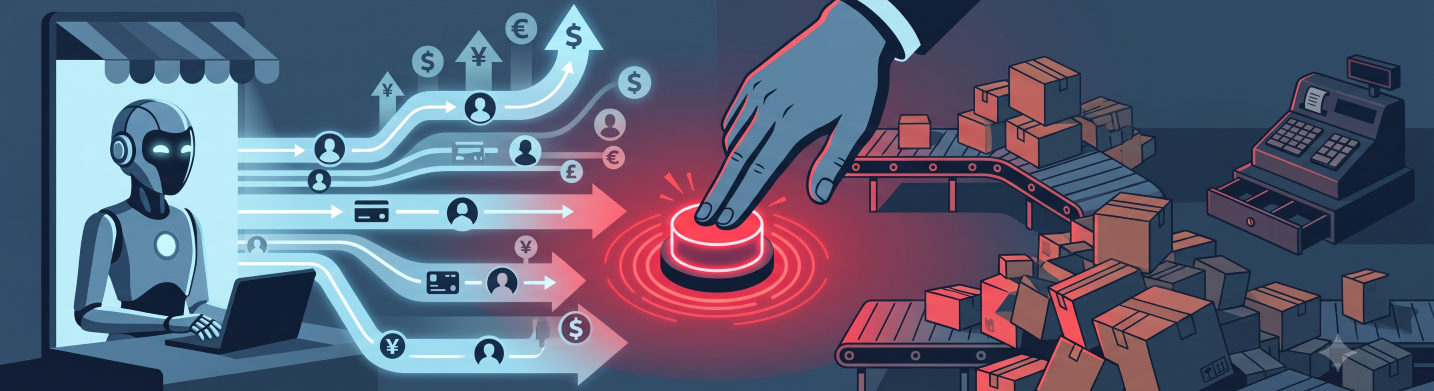
When most enterprise leaders talk about "securing" a generative AI chatbot, the conversation almost always defaults to safeguarding against privacy leaks and keeping proprietary data safe. But if you're myopically focused on confidentiality, you are missing two-thirds of the CIA triad. Worse than that, when your Gen AI chatbot is generating revenue, integrity and availability aren't nice-to-haves, they're essential to the whole business case.
The industry spent the last few years focused on the confidentiality problem: stopping jailbreaks, blocking prompt injections, and keeping the model from saying what it shouldn't. When a sophisticated prompt injection or an abusive exploit corrupts your chatbot's logic, the immediate threat isn't just what the model might reveal; it’s the systemic damage done when you take that revenue-generating system offline to fix it. This is where resilience takes center stage, and why focusing on it now is so critical.
The clearest evidence comes from an unexpected place: Verizon's first ever 2026 Breach Impact Study (BIS), the financial companion to the Data Breach Investigations Report, that finally puts defensible numbers to the cost of a breach using a few years' worth of insurance claims data. What I found truly novel and impactful, though, was the segregation of that loss into 4 categories: Business interruption, External liability, Loss to threat actor, and Response and recovery. And it's this loss due to Business interruption that we're going to play forward thinking about revenue-generating AI chatbots.
In the BIS, Business Interruption is the loss you incur because you couldn't operate, the revenue and profit that you missed out on while your systems were down. And this deserves the highest level of attention. Business Interruption carries the highest median loss of any category in the dataset, around $90,000 per claim, and its extreme top 2.5% of cases approach $5 million per claim. More telling is the trajectory: Business Interruption grew from 21% of known loss types in 2023 to 32% in 2024, a 51% jump that makes it the single largest loss driver in the study. The authors emphasize that while business interruption appeared in roughly 10% of total closed claims, it was responsible for a disproportionate 22% of overall financial costs. If you sell things for a living, this is your problem specifically: in the Retail vertical, Business Interruption is a staggering 44% of known losses!
For twenty years we've thought about downtime in terms of e-commerce sites, payment gateways, and ERP systems. But in 2026, a growing share of the revenue stack is a generative AI chatbot - quietly both a profit center and a single point of failure. When we play these numbers forward into the generative AI landscape, the risk is both obvious and concerning. If your customer-facing chatbot is pulled offline for 48 hours due to an active attack, the improved revenue capture and conversion rate goes down too - leading to an obvious and expensive Business Interruption event. Recently, chatbots and voice assistants were forecast to drive nearly $290 billion in retail sales, and the generative AI chatbot market itself is projected to grow from roughly $13 billion in 2026 to over $113 billion by 2034. E-commerce brands routinely report high-single to double-digit sales lifts from chat-engaged shoppers. So the impact of even just a few days of downtime can be the difference between making or missing your quarterly earnings.
There are entire 3rd party considerations here as well, especially as we transition to more autonomous, agentic workflows and 3rd party MCP servers. As the industry aggressively transitions from standalone chatbots to agentic AI systems, where models call external supply chain APIs, interact with internal CRMs, and trigger database modifications, the financial blast radius of an unmitigated exploit multiplies. If a vulnerability forces you to sever your model’s API integrations, you have voluntarily introduced a high-cost third-party operational outage. You are effectively paying the severe premium of a tail-risk Business Interruption event because operational resilience was treated as an afterthought during development.
Let's run an exercise on the most likely reason your chatbot goes offline: you take it down yourself. When a public-facing bot is being manipulated, like when the Anthropic-powered vending machine was talked into giving away product, or a retail assistant coaxed into unauthorized discounts, the responsible move is often to pull it offline until you can fix it. That's a self-inflicted Business Interruption, triggered not by a technical crash but by an abuse case you didn't anticipate. DPD experienced this in 2024 when they had to turn off their chatbot because of how it talked to customers, proof these systems come down for softer reasons than a breach. And we don't need to reiterate what happened with Meta's support chatbot.
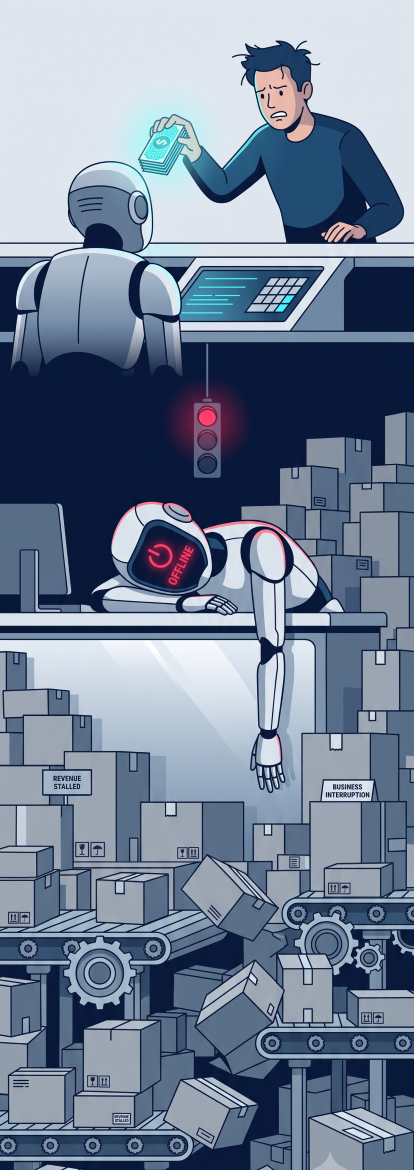
This isn't FUD, and it isn't an argument against deploying chatbots, the ROI is too good to ignore. It's an argument about where the security dollar buys the most business impact, and why resilience needs to be at the top of that list.
The current AI security market is heavily oversaturated with real-time friction. Solutions promise input filtering proxies and inline guardrails that try to catch malicious text as it crosses the wire. But if the 2026 Verizon BIS proves anything, it's that the most severe economic damage of a software exploit isn't the cost of cleaning up code; it's the cost of operational gears grinding to a halt.
To protect enterprise uptime, our security investments must shift left. We need pre-production testing, industry-specific social engineering assessments, and full red-teaming engagements to sit on equal footing with real-time guardrails. We must actively map out behavioral vulnerabilities, prompt extraction loops, and unauthorized data exfiltration paths before the application ever connects to a live customer transaction. Having industry-specific assessments and protections is the most reliable way to find the "I never thought of that" abuse case before an attacker does. Finding the discount-manipulation trick, the data-leakage prompt, or the contingent third-party failure in a controlled environment is orders of magnitude cheaper than finding it as a claim in next year's BIS.
Business Interruption is now the largest, fastest-growing loss category in cyber. If your chatbot generates revenue, it also generates that exposure. Invest in keeping it up, and proving ahead of time, that it can't be talked into coming down. If you want to dig into how this applies to your own AI deployments, reach out to us at questions@generativesecurity.ai.

About the author
Michael Wasielewski is the founder and lead of Generative Security. With 20+ years of experience in networking, security, cloud, and enterprise architecture Michael brings a unique perspective to new technologies. Working on generative AI security for the past 3 years, Michael connects the dots between the organizational, the technical, and the business impacts of generative AI security. Michael looks forward to spending more time golfing, swimming in the ocean, and skydiving... someday.